
Sheet Metal Distortion in Resistance Welding
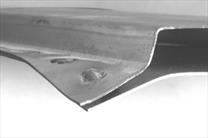
Sheet metal distortion occurs when the weld interface is displaced out of the plane of the sheet metal, or when one or more sheets are deformed from their original plane during welding. It presents in three related forms, each with a distinct geometric cause.
Three Forms of Distortion
Out-of-plane weld — The weld is made at an angle to the plane of the interface. This is caused by electrode faces that are not parallel to the workpiece — when welding force and current are applied at an angle, the resulting nugget forms out of plane with the surrounding metal.
Poor fit-up distortion — The sheets don’t have intimate contact in the weld area before the cycle begins. As welding force and current are applied, one or both sheets distort toward each other to close the gap. The weld forms, but the surrounding material is pulled out of plane in the process.
Offset weld — The weld is displaced from the plane — or planes — of the metals being joined. This typically occurs in combination with fit-up or positioning issues and is often visible as a raised or sunken weld zone relative to the surrounding sheet.
Detection
Post-weld visual inspection of the workpiece is the standard detection method. Surface appearance and flange geometry are the primary indicators.
Why It Matters
Distortion thins the metal in the affected area, which can reduce weld strength relative to a correctly formed joint. The distorted surface may not meet appearance requirements. On flanged assemblies, distortion can interfere with the fit of rubber seals and affect sealing performance downstream. See also: Mislocated/Edge Welds.
Where to Start Troubleshooting
The strong-possibility causes point primarily to positioning, fixturing, and part condition — not weld parameters.
Part fit-up and condition — Poor or varying part fit-up is the most common contributor to distortion. If sheets aren’t in consistent contact before the weld fires, force application during the cycle does the work of closing the gap — and that force goes into deforming the metal rather than forming the nugget. Damaged parts introduce the same problem. Verify that parts are seating fully and consistently in the fixture before each cycle, and inspect incoming parts for pre-existing deformation.
Gun equalization and electrode positioning — Inadequate or absent gun equalization means the gun can’t self-align to the workpiece, so force is applied unevenly across the electrode faces. Combined with incorrect workpiece selection or poor weld accessibility that forces a compromised electrode approach angle, this produces the out-of-plane condition reliably. Verify gun equalization function and confirm that electrode approach geometry is correct for the joint configuration.
Fixture and location accuracy — Wrongly located welds — from fixture drift, robot error, or operator variation — place the weld in a location where fit-up, flange geometry, or sheet orientation isn’t what the weld schedule was designed for. If distortion is systematic rather than intermittent, check weld location against the drawing before investigating equipment or process parameters.
Possible Causes
Strong Possibilities
- Damaged part
- Inadequate or no gun equalization
- Incorrect workpiece selected
- Poor or varying part fit-up
- Poor weld accessibility
- Welds wrongly located by fixture/robot/operator
Weak Possibilities
- Electrode skidding/sliding
- Inadequate electrode alignment
- Incorrect hoses
- Incorrect test procedure
- Tip faces not parallel to workpiece
- Wrong cable/shunts
- Wrong shank
- Wrong tips
Note: Also see Mislocated/Edge Welds