
Electrode Alignment in Resistance Welding
Electrode misalignment is present when either of two conditions exists at the welding position: the contact faces of the upper and lower electrodes are not parallel to one another, or their center points are not coincident — that is, they don’t share the same axis. Either condition alone is sufficient to cause weld quality problems; both can be present simultaneously.
Two Types of Electrode Misalignment
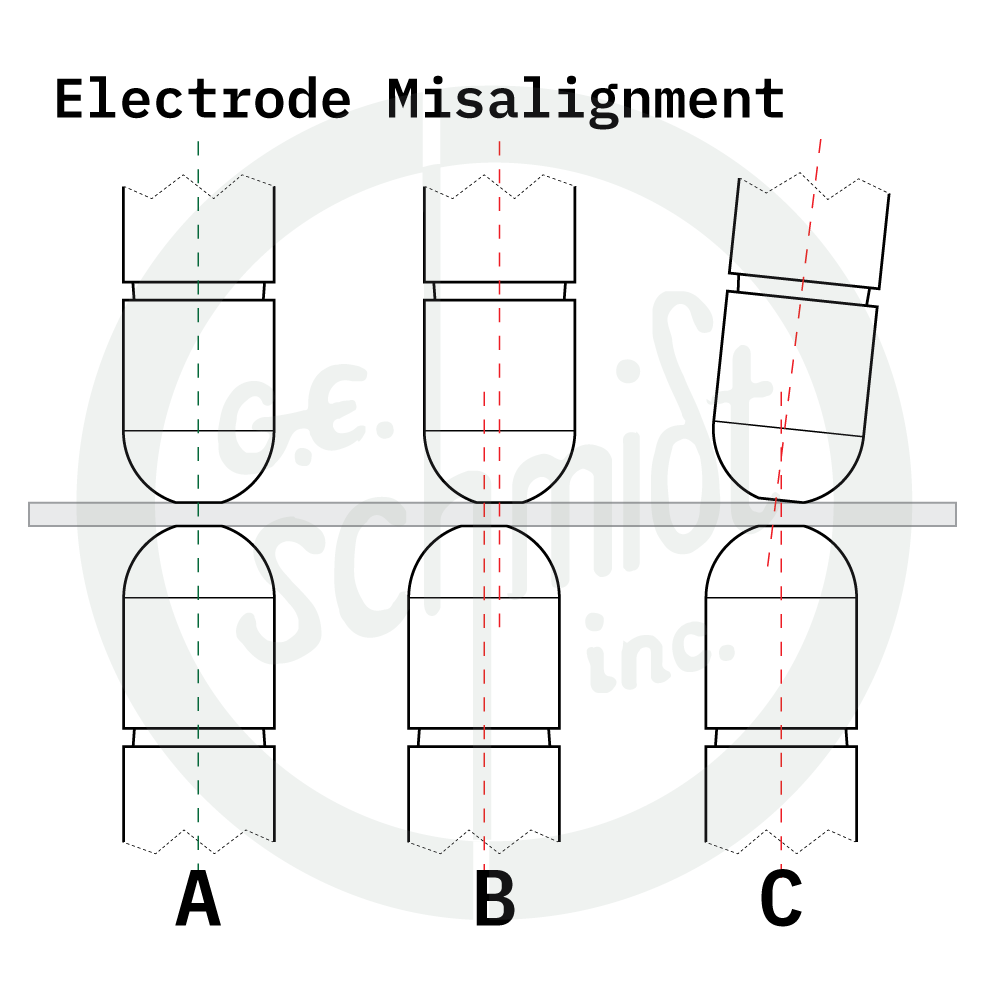
Axial misalignment The electrodes are offset laterally — their centerlines are parallel but displaced from one another. The weld contact zone shifts off-center, concentrating force and current asymmetrically across the joint.
Angular misalignment The electrode faces meet at an angle rather than flat against each other. This is sometimes called angularity. It produces uneven contact pressure and current density across the face, which distorts nugget shape and accelerates wear on the high-contact side of the tip.
Note that in some cases. with an X gun or a rocker arm welder, the length of the arms can cause electrode misalignment. Longer arms, when possible, result in less misalignment. Tip dressing immediately after a tip change (and before welding) may also help with alignment.
Both types are visible in the diagram above. Figure A shows acceptable configurations. Figure B shows axial misalignment. Figure C shows angular misalignment.
What Misalignment Produces
Poor electrode alignment is a contributing cause to a range of weld quality issues. If you’re seeing any of the following, alignment should be on the inspection list:
- Electrode skidding/sliding
- Expulsion/burn-through
- Cracks and holes
- Mislocated/edge welds
- Non-round welds
- Sheet metal distortion
- Poor Class A appearance
- Undersized welds
Detection
Three inspection methods will reliably reveal misalignment:
- Close the gun without a workpiece and observe how the tip faces meet. Offset or angled contact is visible directly.
- Watch the workpiece during welding. Twisting or torquing of the part under electrode pressure indicates that force isn’t being applied on-axis.
- Inspect weld indentations on the finished part. Asymmetrical or offset indentations are a clear indicator of misalignment at the time of welding.
Why It Matters
Misalignment affects quality, cost, downtime, throughput, maintenance burden, and workplace safety. The maintenance impact deserves specific attention: misaligned electrodes wear unevenly and at an accelerated rate. Teams that don’t address alignment find themselves dressing or replacing tips far more frequently than the application requires. Correcting alignment is one of the most straightforward ways to extend electrode life and reduce unplanned maintenance.
Subordinate Causes
When tracking the source of misalignment, these are the most common contributors:
- Poor mechanical connection at the gun body or arm interface
- Wrong shank — incorrect taper, length, or geometry
- Wrong tips for the application
- Poorly fixtured parts shifting under electrode pressure
- Worn weld gun with looseness in the arm or pivot points